
A Review of Red Rocket Readers Decodable Explorers: Fluency Launch.
As a literacy teacher educator and former reading teacher, I understand the importance of phonics instruction and using decodable texts as *one approach* to teaching decoding. What I don’t understand is why I’ve seen some decodable texts in classrooms that are not only unappealing, but poorly written and lack diverse representation of people and characters. I wonder, can we have it all? Meaning, can we have books that are decodable, appealing, and meet Bishop’s (1990) call for including mirrors of our own experiences, and windows and sliding doors into the experiences of others?
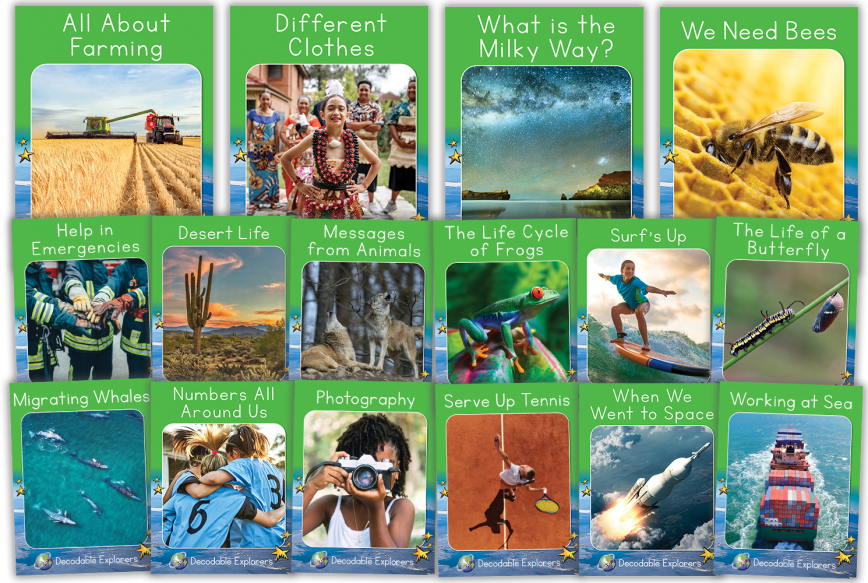
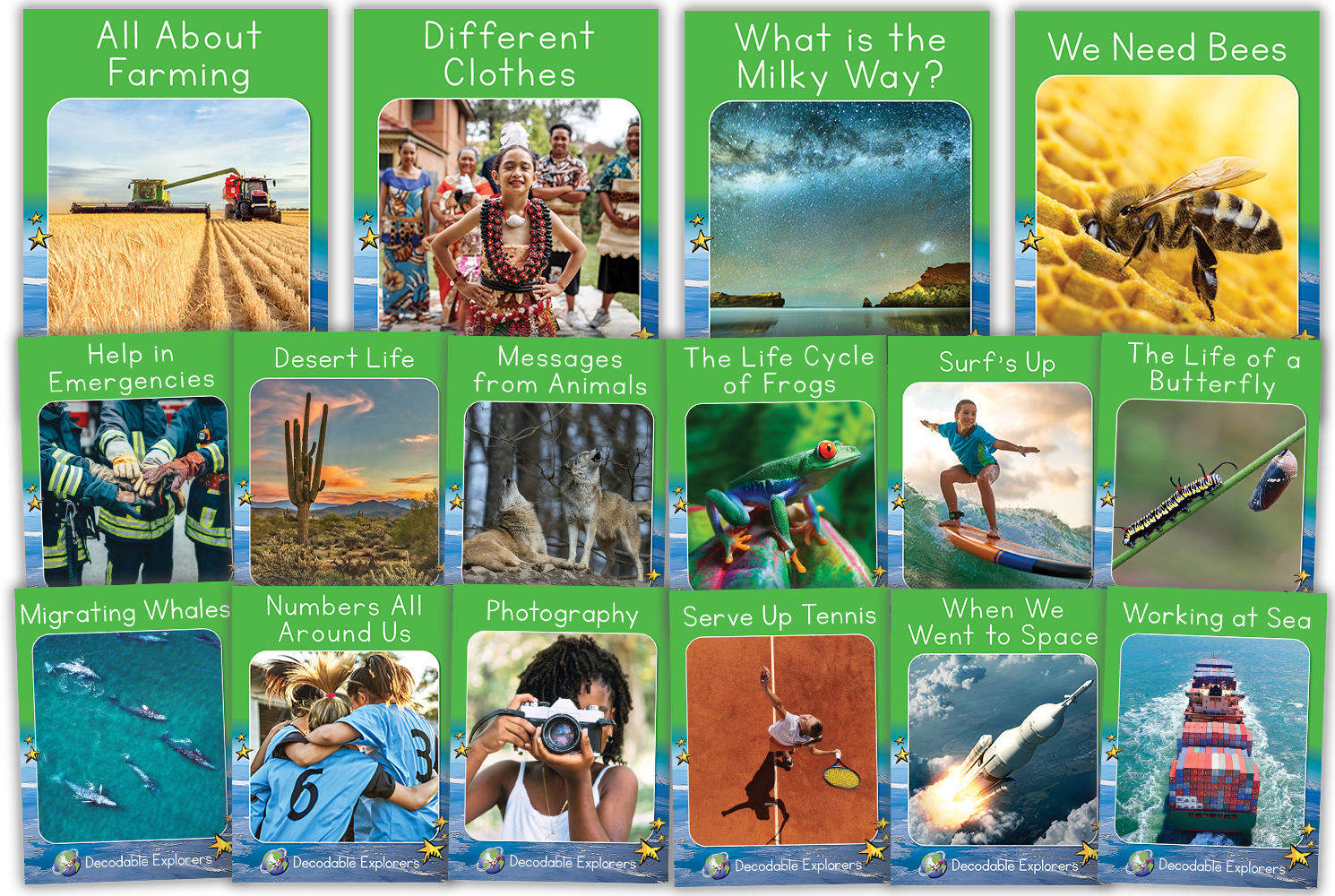
This is why, whenever I receive a box of Red Rocket Readers Decodable Explorers, I tear into it as soon as possible, knowing that what I will find is the opposite of what I described above. This particular box unpacking experience was no different. I found 16 titles, 16 pages each – the perfect length for reading in one sitting. All 16 titles in this series are nonfiction informational texts. The topics range from surfing to photography to space, and of course include the ever popular topic of animals. Here, I didn’t find one book that wouldn’t delight a group of young readers. The photographs are lovely – they are bright, colorful, and take up the entire page spreads in each book. This alone will draw readers into the books.
As an analyzer of decodable texts, I am overjoyed to see the representation of people. The book Different Clothes is an exemplar in this category because children can not only see themselves in the pages; they also see the faces of others that helps them to understand other human experiences. The series also presents a balance of gender, with women farming the land and girls playing sports.
…written so beautifully that there is a healthy relationship between phonics skill words and natural sounding book language.Bethanie C. Pletcher Ed.D
Another element I look for in high-quality decodable texts is the balance between focus phonics skill words and the comprehensibility of the text. Often, what we find in decodable texts is that the storyline and natural language is sacrificed for the inclusion of as many phonics skill words that can be packed in. This result is what Goodman (1965) labeled “Primerese,” and you’ll know it when you see it as the text will be so choppy and forced that it’s difficult for even an adult to read out loud! The Fluency Launch Decodable Explorers books are written so beautifully that there is a healthy relationship between phonics skill words and natural sounding book language. Here’s an example from Surf’s Up:
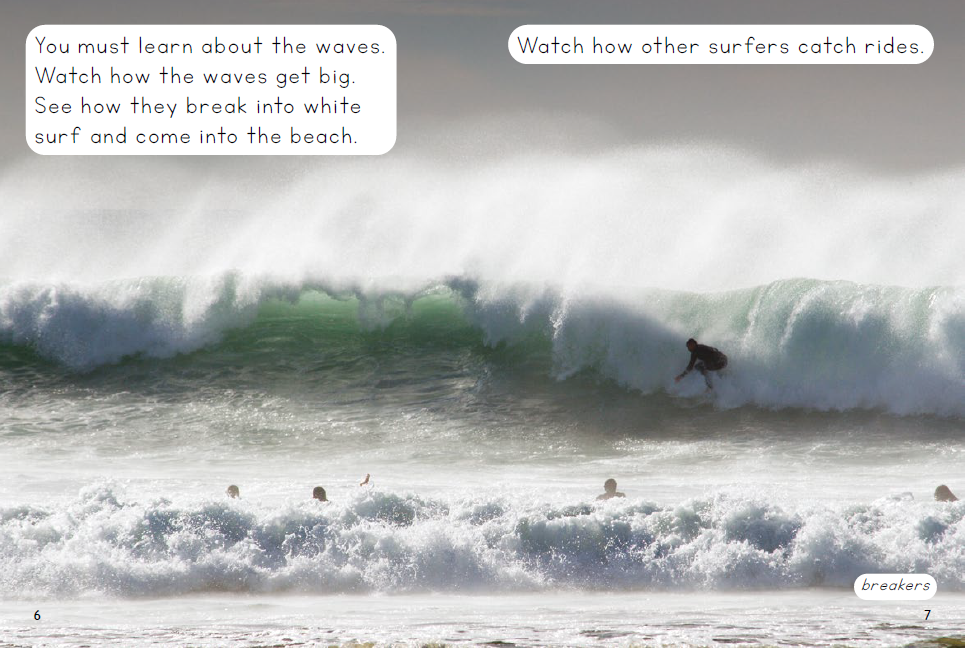 You must learn about the waves.
Watch how the waves get big.
See how they break into white
surf and come into the beach.
Watch how other surfers catch rides.
Notice that the phonics skills (spellings of /er/ and /ch/) are presented within the context of lovely prose. Robust vocabulary is also included in this set of books – in this book, words like paddle and balance help to make decodable text sound like authentic.
As with all other Red Rocket Readers, the Decodable Explorer texts feature a teaching plan inside the front cover that includes a sample book introduction, teaching ideas to support foundational skills, and key vocabulary. More detailed lesson briefs, lesson plans, and activity sheets are available for books on the Flying Start Books website. These resources are wonderful for busy teachers and can serve as a springboard to other instructional activities.
So now that you’ve found some high-quality decodable texts, what is the best way to use them in the classroom with your young readers? Remember that the purpose of decodable texts is to support phonics features that your students are learning. So, even though comprehension is, of course, the most important part of reading a text, these books are written with decoding practice in mind. What is so special about the Decodable Explorers is that they provide decoding practice while also supporting comprehension.
A small group lesson with a decodable text will look different from a guided reading lesson, mainly because instead of a teaching point made “on the run,” there is a focus phonics skill that will be predetermined and will be taught before, during, and after the children read the text. Here is a lesson sequence I suggest using when working with decodable texts:
- Introduce the text. Invite the children to look through the illustrations/photos and talk about them. Introduce any new vocabulary.
- Remind the children about the phonics pattern you have been studying and show them an example by writing a word or two from the text on a whiteboard. Invite them to locate another word or two with this phonics pattern in the text. Say the word, have them repeat it, locate it, and say it while running their finger under the word. Write the word on the board and underline the phonics pattern. Have them frame the phonics pattern in the word with their fingers in their book.
- The children will then read the text. Because the text is decodable and because this text should be one where the only new information is in the newest phonics skill presented, readers should be able to read the text to themselves, out loud so that you can listen in. You can also have them read with a buddy or read the text chorally. Do not have the children read the text “round robin” style.
- As children are finishing the text, invite discussion about the story if fiction and new things learned if nonfiction.
- Ask the children to “collect” the words that contain the phonics pattern they are working on by having them use sticky notes. Write these on a white board as they share and underline the phonics pattern.
- Wrap up the lesson with transfer. Show them a new word with the phonics pattern that is not in the text and challenge them to read it or tell them a new word with the phonics pattern that is not in the text and challenge them to write it.
Again, educators want it all in decodable texts, and with Flying Start’s Decodable Explorer series, we can have it!
Happy Reading!
About the Author
